
Explainer
Why brass fittings hold up in seawater
Seawater does not forgive the wrong material. Here is how brass behaves against stainless, what galvanic corrosion does, and how to choose through-hulls, valves and strainers.
On a boat, every fitting below the waterline works inside an electrolyte. Seawater is not simply a liquid – it is a conductive solution that drives electrochemical reactions between the metals of the installation.
That is why material choice in marine fittings is not made on “which is strongest” but on “which behaves predictably in this environment, next to these other metals”.
What seawater does to metals
Three mechanisms work at once. The first is general corrosion: the surface oxidises gradually and evenly. It is the benign type, because it is visible and predictable.
The second is localised attack. Chloride ions from the salt break the protective film of certain alloys locally and create pitting, or corrosion inside crevices where water sits still and oxygen cannot reach. This is the dangerous type, because the fitting looks clean while it is perforating from within.
The third is galvanic corrosion. When two different metals are in contact inside seawater they form a couple, and the less noble one corrodes faster than it would on its own. The same valve that lasts ten years in one installation can fail in two if it is threaded onto the wrong metal.
Brass and stainless in seawater
Brass is an alloy of copper and zinc. Copper alloys are the traditional material for marine fittings for specific reasons: they corrode mostly evenly rather than through hidden pitting, they do not readily develop biological fouling on their surface, and they machine easily into threads that seal reliably.
Stainless has the opposite profile. In air and in well oxygenated water it performs superbly, because the chromium oxide film reforms continuously. In stagnant seawater, however, inside crevices and under deposits, oxygen does not reach, the film is not restored and localised attack appears.
What matters for any copper alloy is that it matches the application. Each fitting’s specification states what is suitable for permanent seawater contact and what belongs on secondary lines; it is worth checking rather than taking as given.
Through-hull fittings
Through-hull fittings pass through the hull and allow water in or out – engine cooling, bilge, drainage. They are among the few points where a failure means not a leak but an ingress.
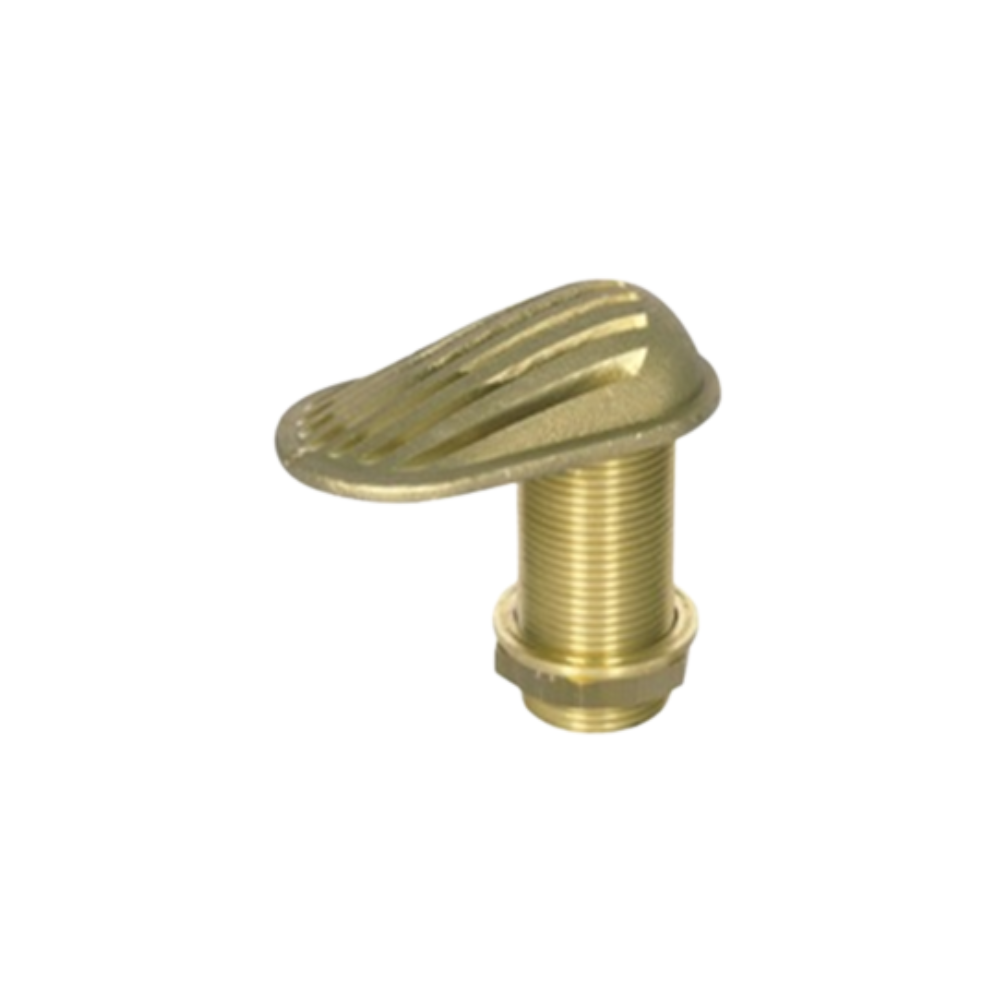
The range covers two basic geometries. The straight type passes vertically through the hull. The intake strainer type has a shaped foot that beds against the outer surface, distributing the load better.
The fitting is never alone: the brass nut provides the clamping and the washer the watertight seating. All three have to belong to the same system and match the thickness of the hull.
Brass marine fittings
Through-hulls, valves, strainers and the parts that go with them.



Marine ball valves
The ball valve is what isolates the line immediately after the through-hull. Two characteristics set it apart from any other valve.
The first is full bore: the hole through the ball has the same diameter as the pipe, so when the valve is open the flow is not throttled. On an engine cooling line that counts directly.
The second is the quarter turn. Open or closed with one movement, and the position is visible from the lever without having to test it. In an emergency that is the difference.
See the full range under ball valves, while larger permanent connections are made with flanges.
Water strainers
Everything that enters through the through-hull ends up at the pump. Sand, weed, plastics and marine organisms destroy impellers and block heat exchangers. The water strainer catches them at a point that opens and cleans easily.
Sizing follows the line, with the water strainers in the catalogue covering 3/4″ to 4″. A strainer smaller than the line means throttling and more frequent blockage.
The lid is the consumable part: it opens and closes dozens of times a season and its gasket tires. It is available separately as a spare, so a worn lid does not mean replacing the whole strainer.
Maintenance
Exercise the valves
Open and close every valve periodically. Valves left in one position for years seize.
Clean the strainer
Check and empty the strainer regularly, depending on the waters you operate in.
Watch the colour
A pink or reddish tone on a brass surface indicates zinc loss and needs attention.
Dissimilar metals
Avoid direct contact between different metals on the same line, so galvanic couples do not form.
The annual haul-out is the opportunity to check every point below the waterline together, rather than one at a time as each develops a problem.
View the brass marine fittings →
Frequently asked questions
Brass or stainless for seawater?
What is galvanic corrosion?
What is a through-hull fitting?
What size water strainer do I need?
Why has a brass fitting turned pink?
Request a quote or information
Fill in the form and we will get back to you as soon as possible.