
COMPARISON
Camlock in aluminium, brass or stainless steel: which material for each use
Same coupling, three materials. See where aluminium fits, where brass and where stainless steel, what changes in chemical resistance and cost, and how to choose with a table per application.
In short: in the camlock aluminium vs brass vs stainless comparison, aluminium is the lightest and most economical metal camlock, for water, oils and petroleum products. Brass handles salt water well and suits boats and fuels. Stainless steel has the widest chemical resistance and is the choice for food, chemicals and marine use. The fluid and the environment decide the material, while pressure depends mainly on size.
There is no single winner among the three materials. All three couple the same way, so the choice comes down to the fluid that will pass, where the coupling will work and how long you want it to last.
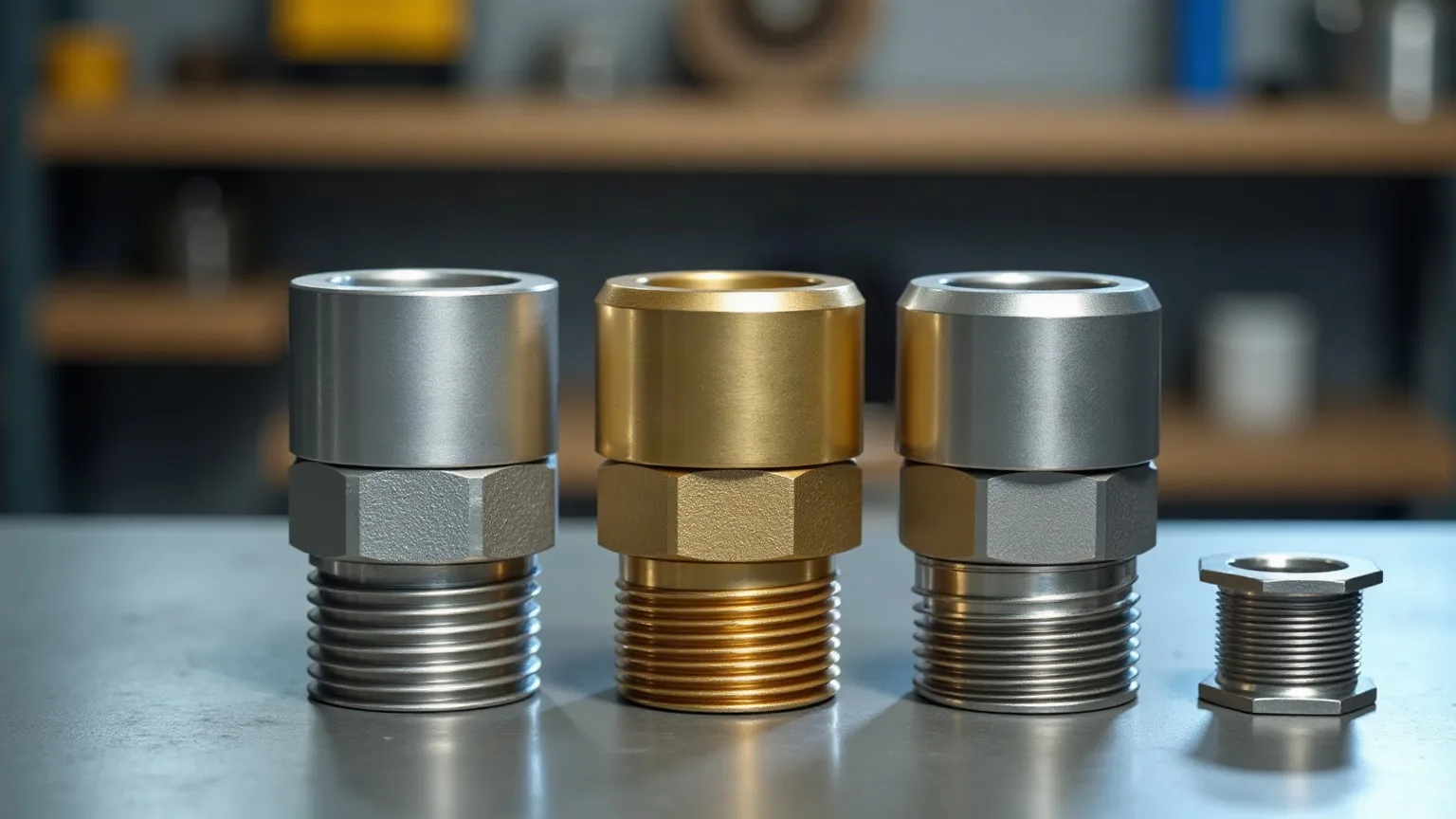
Camlocks from our catalogue in types A and C, in aluminium, brass and stainless steel:

CAMLOCK TYPE A ALUMINUM
Aluminium type A coupling: plug with a female thread.

CAMLOCK TYPE A BRASS
The same type A in brass, for salt water, boats and fuels.

CAMLOCK TYPE A STAINLESS STEEL
Type A in stainless steel, for food, chemicals and marine use.


CAMLOCK TYPE C STAINLESS STEEL
Type C in stainless steel, with a hose shank.
Aluminium: light and economical
Aluminium is the lightest of the metal camlock materials and the most economical. It has good corrosion resistance for general use, such as fresh water, oils and petroleum products. That is why you see it on water pumps, with hydraulic oils and on fuel lines, often together with fuel delivery rubber hoses. The low weight matters at large sizes and when the coupling is connected and disconnected often. For its weight, it is durable and has good pressure and temperature ratings.
Its weak point is chemical resistance. Aluminium is not suitable for strong acids, alkaline solutions and highly corrosive chemicals. Outdoors and in salt water it corrodes over time, so brass and stainless steel last longer there. See our aluminium camlocks in all types.
Brass: strength and marine use
Brass is heavier than aluminium, about as heavy as stainless steel, and softer than stainless steel. It has good corrosion resistance, especially to salt water and brine. That is why it is widely used on boats, like the rest of our brass marine fittings.
It also suits water, petrol, petroleum products and hydraulic oils, and handles coolants well. Like aluminium, it is not for strong acids and alkalis. If the coupling will work at sea, our guide on why brass fittings withstand seawater explains the difference from stainless steel. See our brass camlocks.
Stainless steel: corrosion and food
Stainless steel is the most durable of the three materials and has the widest chemical resistance. It resists chloride corrosion, as in seawater, and handles the highest temperatures. It is used for potable water, food and beverage, water treatment, chemicals, pharmaceuticals and shipbuilding. It comes in grades 304 and 316, with 304 being the more economical.
In food applications the surface matters too: grade 316 stainless steel has a smooth, non-porous surface that is easy to clean and sanitise. Even stainless steel can be attacked by certain highly aggressive chemicals, so check the manufacturer’s compatibility chart for each chemical. See our stainless steel camlocks.
Chemical compatibility
The camlock body is only half of compatibility. The fluid is also in contact with the gasket, which often sets the maximum temperature of the coupling. That is why you choose the body material and the gasket together, for the fluid that will pass.
Metal camlocks usually come with an NBR (Buna-N) gasket and plastic ones with EPDM. For fuels, chemicals or high temperatures, see our comparison of neoprene and viton gaskets and the available camlock gaskets. As a general guide:
- Water, oils and petroleum products: aluminium, brass or stainless steel.
- Salt water: brass or stainless steel.
- Strong acids and alkalis: not aluminium or brass, but stainless steel or polypropylene, after a compatibility check.
- Organic solvents: polypropylene may not be suitable.
Polypropylene is the lightest and cheapest material and resists many acids and alkalis, but it has the lowest pressure and temperature resistance, and its working pressure drops as the temperature rises.
Cost vs service life
Aluminium is the cheapest of the metal camlocks. Brass and stainless steel cost more, and the order between them is not fixed: in some markets 304 stainless steel has become cheaper than brass. For an exact comparison, ask for a price for the type and size you need.
The cheapest option is not always the most economical. An aluminium camlock in salt water or an aggressive chemical will corrode and need replacing. Stainless steel costs more, but in harsh or critical applications it gives the best balance of cost and service life. For general use with water or petroleum products, aluminium is usually enough.
Lifespan also depends on how the coupling is used. Over-tightening damages the thread, while under-tightening causes leaks. When coupling, close both arms fully against the coupler body and fit safety pins where available.
Selection table by application
| Application | Material | What to watch |
|---|---|---|
| Water, pumping, general use | Aluminium | Not for permanent use in salt water |
| Fuels, oils, petroleum products | Aluminium or brass | A gasket suitable for the fuel |
| Boats, seawater | Brass or stainless steel | Stainless steel where chlorides and cleaning are involved |
| Food, potable water | Stainless steel | A gasket suitable for the product |
| Chemicals, acids, alkalis | Stainless steel or polypropylene | A compatibility check for each chemical |
Pressure does not separate the three metals much. In the Dixon catalogue, aluminium, brass and stainless steel camlocks of the same size have the same working pressure, which falls as the size increases. Other manufacturers give stainless steel a higher limit, so the manufacturer’s chart always applies.
| Size | Metal (Dixon) | Polypropylene (Dixon) |
|---|---|---|
| 20-50 mm | 250 psi (about 17 bar) | 100-125 psi (about 7-8.6 bar) |
| 75 mm | 125 psi (about 8.6 bar) | 60 psi (about 4.1 bar) |
| 100 mm | 100 psi (about 6.9 bar) | 50 psi (about 3.4 bar) |
Frequently asked questions
What pressure can a camlock handle?
Does a stainless steel camlock handle more pressure than an aluminium one?
Which camlock is best for seawater?
Which camlock is suitable for food?
Can I use camlocks for compressed air or steam?
Sources
- Pro Flow Dynamics, Cam & Groove Fittings: Which Material Is Right For You? https://www.proflow-dynamics.com/blog/cam-groove-fittings-which-material-is-right-for-you.html
- Pro Flow Dynamics, 5 Common Mistakes to Avoid When Using Camlock Fittings. https://www.proflow-dynamics.com/blog/5-common-mistakes-to-avoid-when-using-camlock-fittings.html
- Varco Pumper, Choosing the Right Camlock Material for Your Application. https://www.varcopumper.com/choosing_the_right_camlock_material_application.asp
- Dixon, Camlock Product Range Brochure. https://australia.dixonvalve.com/sites/default/files/documents/camlock_product_range_brochure.pdf
Request a quote or information
Fill in the form and we will get back to you as soon as possible.