
EXPLAINER
Pipe flanges: types, materials and correct sealing
Brass, lathe-machined steel, oval pump flanges and hose tail flanges. Here is what each one does, how the gasket seals and how to tighten the bolts correctly.
In short: the main types of pipe flange are threaded flanges, which screw onto a threaded pipe, weld-on flanges, blind flanges, which close off the end of a line, and special designs such as oval pump flanges and hose tail flanges for rubber hose. The seal itself is made by the gasket between them.
A flanged joint can be taken apart and put back together without cutting or welding. For it not to leak, three things have to match: the flange, the gasket and the way the bolts are tightened.
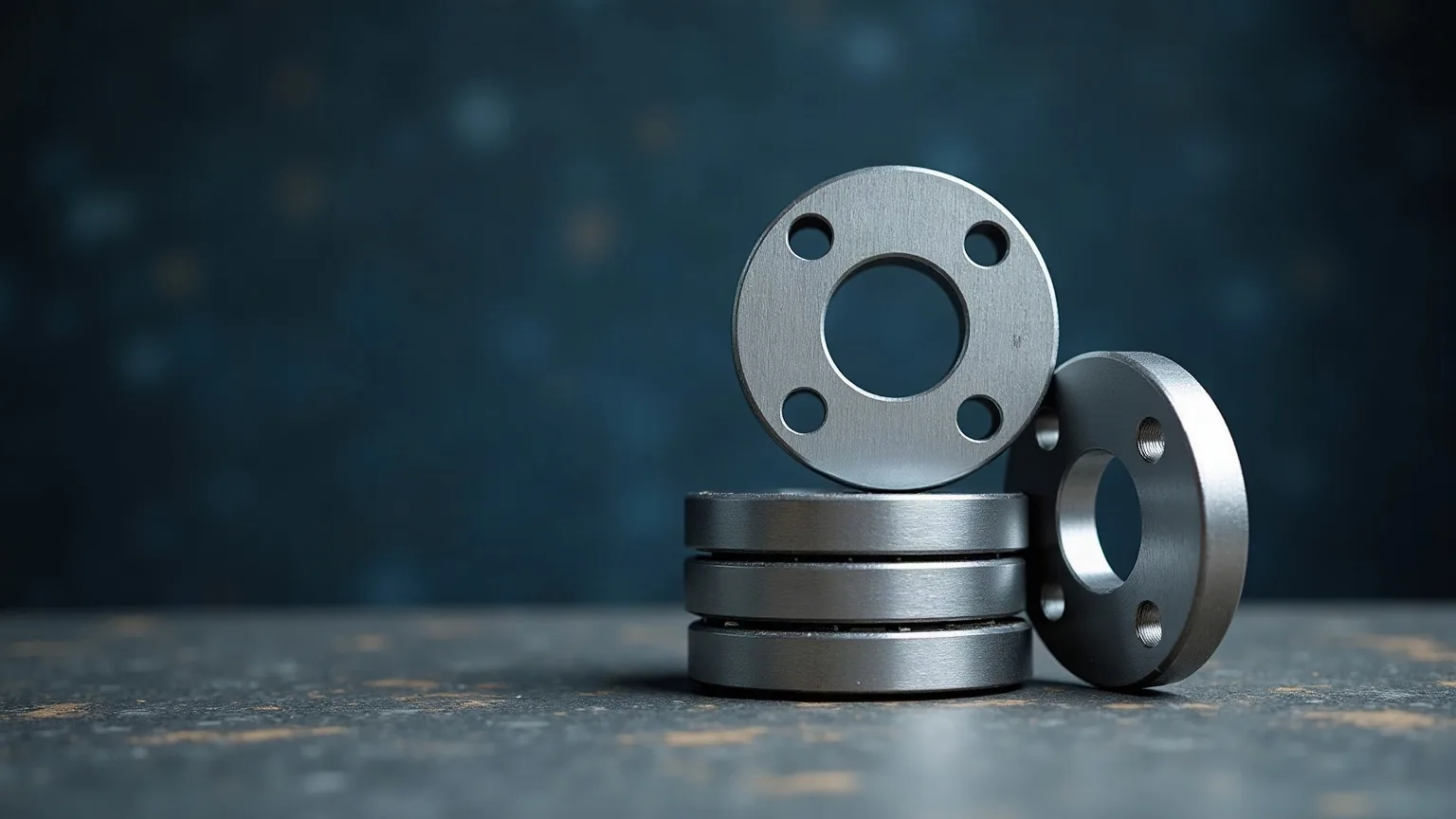
What a flange does
A flange, one of the basic hose and pipe fittings, is a disc with bolt holes that is fixed to the end of a pipe or fitting. Two flanges are bolted together with a gasket between them: the bolt load is transferred to the gasket and compresses it, closing every leak path.
Its advantage is that the joint can be taken apart. That is why a flange goes where a component, such as a valve or a pump, may need to come out for maintenance and go back in. In a welded line, by contrast, removing a component means cutting.
In the catalogue each flange is described by the pipe size, the bolt circle, meaning the diameter of the circle on which the holes sit, the number of holes and the thickness. For two flanges to mate, they need the same bolt circle and the same number of holes. The main types:


IRON LATHE THREADED FLANGES
With bolt circle, holes and thickness for each size.


Brass flanges
The brass flanges in the catalogue are threaded: they screw onto the pipe or fitting, with a male or female thread depending on the code. The advantage of a threaded flange is that it is fitted without welding.
Threaded flanges are used mainly on smaller sizes and do not suit thin-walled pipe. As with any threaded joint, for example with galvanised pipe fittings, the thread of the flange has to match the thread of the pipe.
Brass is an alloy of copper and zinc and a traditional material for marine fittings. For how it behaves in seawater, see the guide on brass marine fittings.
Lathe-machined steel flanges
The steel lathe flanges are machined on a lathe and are available in the catalogue as threaded, weld-on and blind versions.
The threaded flange screws onto a threaded pipe, just like the brass one. The weld-on flange is welded to the pipe: the joint with the pipe becomes permanent, while the connection to the opposite flange can still be taken apart.
A blind flange has no centre hole. It closes off the end of a pipeline, a valve or an opening in a vessel, and it is removed when the line needs to be extended or inspected.
The thickness is given for each size, for example 12 mm for the 1″ flange and 16 mm for the 1 1/4″ flange. For threaded flanges the catalogue also gives the bolt circle and the number of holes, e.g. 85 mm and 4 holes for the 1″ flange.
Oval & special flanges
Oval pump flanges connect the pipework to the pump port. For some sizes the catalogue gives more than one bolt circle, e.g. 70-73-75 mm for the 1″ flange, so measure the bolt circle on your pump before ordering.
For rubber hose there are flanges with a hose tail and claw, in fixed and swivel versions. The tail goes inside the hose and the flange bolts to the matching flange of the installation. The swivel version rotates, which makes it easier to line up the holes without twisting the hose. Here too the bolt circle decides compatibility: on the 3″ hose tail flange it is 152.4 mm with 4 holes, while on the 4″ it is 190.5 mm with 8 holes.
For shipping there are threaded steel slops flanges for bilge residues, and the International Fire Shore Connection flange, which is supplied complete with washers, bolts and nuts.
Gaskets & sealing
The gasket is the part that does the sealing. It always goes in new: an old gasket is never reused, and two gaskets are never stacked on top of each other.
Before fitting, clean and inspect the flange faces, bolts, nuts and washers, and replace anything that is worn. Centre the gasket between the flanges before the nuts are tightened, and use hardened steel washers under the nuts.
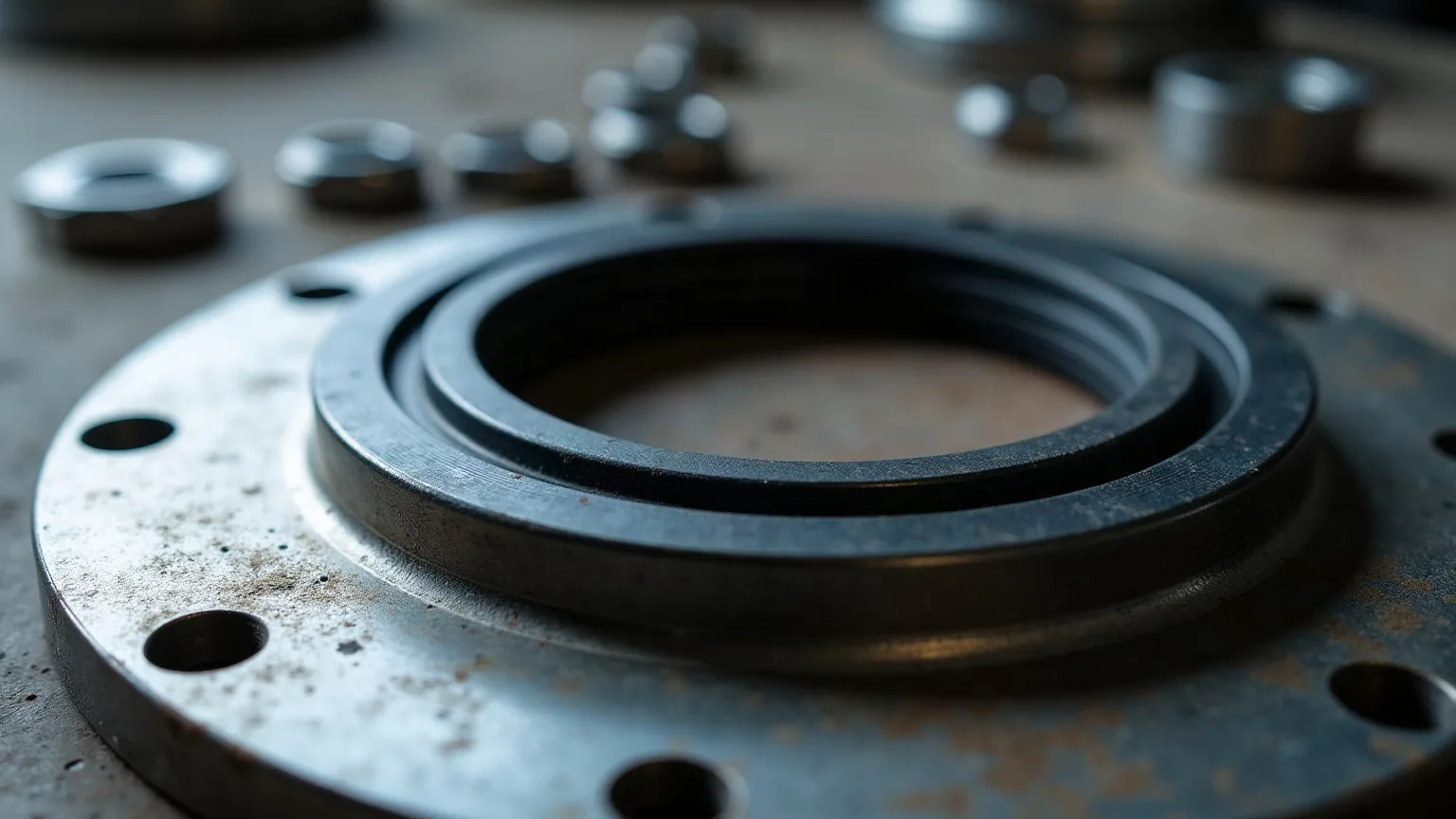
The gasket material is chosen for the fluid and the temperature of the line, with the same logic that applies to neoprene and Viton gaskets.
Bolt tightening
The final torque is not the same for every joint. What stays the same is the procedure, which spreads the load evenly over the whole gasket:
Lubrication
Lubricate the bolts, the nuts and the surfaces the nuts bear on.
Hand tightening
Run all the nuts down by hand and number the bolts in a crisscross order.
Staged tightening
With 4 to 8 bolts, tighten in a crisscross pattern to 30%, 60% and 100% of the final torque. With 12 bolts, to 20%, 40%, 80% and 100%.
Circular pass
At 100%, go round clockwise from bolt 1 until no nut turns any further.
After each stage, check that the gap between the flanges is the same all the way round. In the first 4 to 24 hours part of the bolt preload can be lost, so a repeat circular pass after 24 hours restores it. This matters especially with PTFE gaskets.
Frequently asked questions
What is a pipe flange?
What is a flange gasket?
What is a threaded flange?
What is a lathe-machined flange?
Sources
- Wermac, Types of Flanges. https://www.wermac.org/flanges/flanges_welding-neck_socket-weld_lap-joint_screwed_blind.html
- Gasket Resources Inc., Gasket Installation. https://gasketresources.com/technical-info/gasket-installation/
- Boshart Industries, How to Install a Gasket and Flange. https://support.boshart.com/how-to-install-a-gasket-and-flange
- KLINGER, Installation Manual for KLINGER Gaskets. https://www.sealanddesign.com/wp-content/uploads/2026/04/Klinger-Gasket-Installation-Manual.pdf
- Pumps & Systems, How to clean, align, install, lubricate and tighten gaskets for ideal results. https://pumpsandsystems.com/best-practices-gasket-installation
- IMO, International Code for Fire Safety Systems (FSS Code), Resolution MSC.98(73). https://puc.overheid.nl/doc/PUC_2394_14/7
Request a quote or information
Fill in the form and we will get back to you as soon as possible.