
EXPLAINER
Fire hose cabinets: what they must contain under the regulations
A fire hose cabinet is more than a red box with a hose. Here is what Greek Fire Regulation 15/2014 sets for the hose, the cabinet and the mounting height, when you need a cabinet for a permanent fire main to EN 671, and how it is inspected every year.
In short: the cabinet of a simple water supply network, which Greek Fire Regulation 15/2014 calls a fire hose cabinet, is metal, red and marked, and holds a rubber hose 15 to 19 mm in diameter and 20 m long with a nozzle. It is mounted 1 to 1.5 m above the floor. A cabinet on a permanent fire main follows Technical Guideline TOTEE 2451/1986 and ELOT EN 671.
What a fire hose cabinet contains depends first on the network it is connected to. The same name covers the small cabinet with a garden-style hose and the larger cabinet with a valve, hose and branch pipe on a permanent fire main. The rules for the two are different, and that decides what you order and how you inspect it.
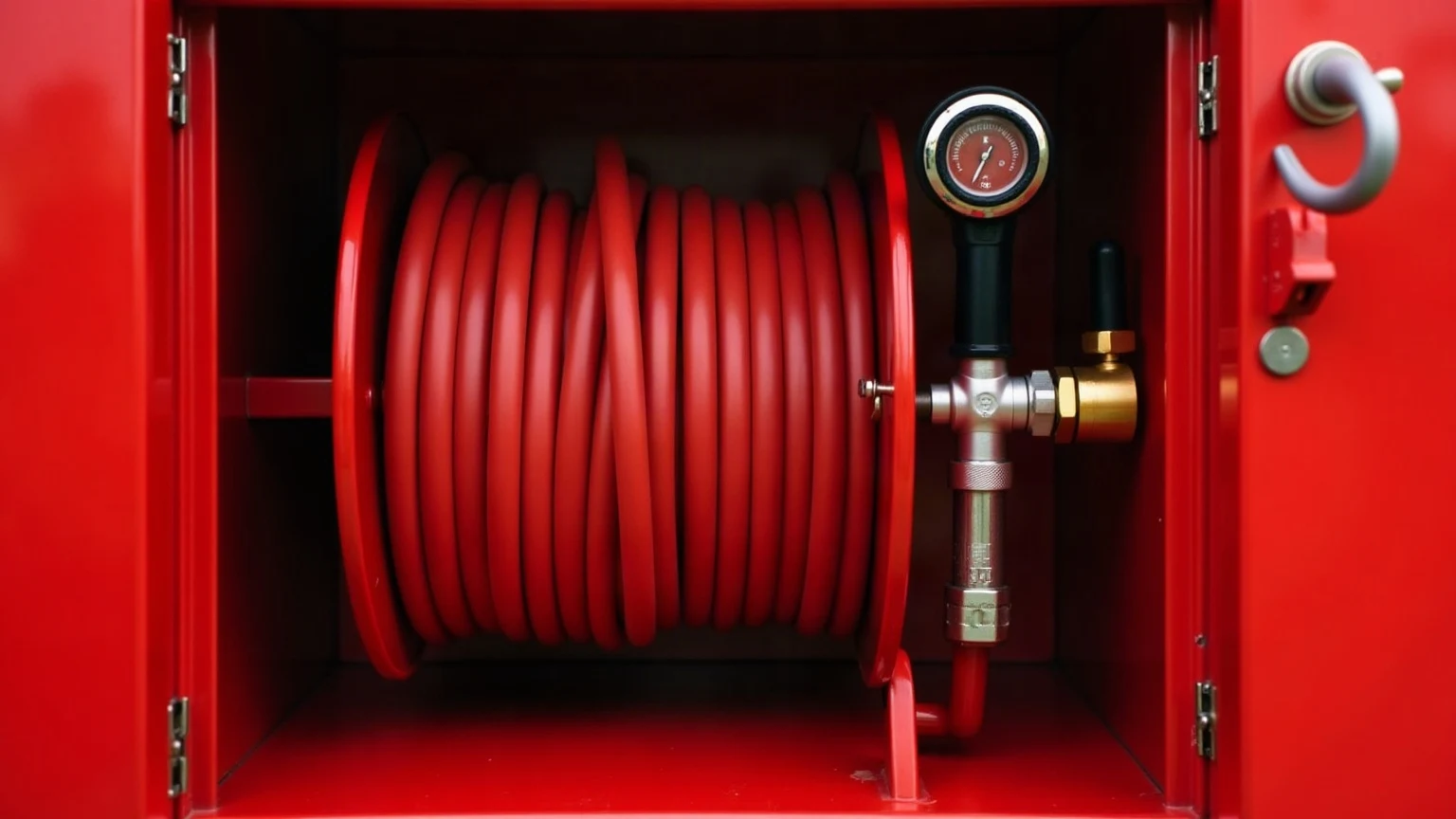
Some of the parts that go into a permanent-network fire hose cabinet, from our catalogue:

“UNI-A / UNI-AN” FIRE FIGHTING HOSE, MED CERTIFIED, 15 BAR
White, with 15 bar working pressure and 45 bar burst pressure, in rolls from 15 to 60 metres.
“UNI-C / UNI-CR” FIRE FIGHTING HOSES, MED CERTIFIED, 15 BAR
Red, with the same pressure rating and EN 14540 certification up to 2 inches.

ALUMINUM 4 POSITION ADJUSTABLE NOZZLE
Aluminium nozzle with an adjustable head for 4 jet and spray positions and a male thread for any type of fire coupling.

“STORZ” COUPLINGS ALUMINUM HOSE ENDED
Aluminium coupling with a hose tail for connecting the hose.

BRASS “STORZ” COUPLINGS HOSE ENDED
The same type in brass, with a hose tail.
The role of the fire hose cabinet
A fire hose cabinet is a water outlet inside the building, for use by the occupants or the fire safety team until the Fire Service arrives. It complements portable extinguishers, which hold a limited amount of extinguishing agent, while the cabinet delivers water for as long as the network has supply.
The regulations distinguish two kinds of network. The first is the simple water supply fire network. The second is the permanent fire main, with its own pipework, water source, pumps where needed and cabinets with a valve.
Which one you need is set by the fire regulation for your type of use. For example, for places of public assembly Fire Regulation 3/2015 requires a permanent fire main when the theoretical occupancy exceeds 250 people. In all other cases it requires a simple water supply network.
Mandatory equipment
For the simple network, article 4.3 of Regulation 15/2014 is specific. The cabinet is made of metal, red in colour, with suitable marking. Inside is a rubber hose of 15 to 19 mm diameter, 20 m long, with a nozzle.
For a cabinet on a permanent fire main, article 3 of the same regulation refers to Technical Guideline TOTEE 2451/1986 and to ELOT EN 671, the standard for fixed firefighting hose systems. EN 671-1 covers hose reels with semi-rigid hose and EN 671-2 covers hose systems with lay-flat hose.
Annex B of the older Fire Regulation 3/1981, repealed by 15/2014, described the parts of such a cabinet in detail. Its list explains well what you see when you open the cabinet:
- a valve, connected to the network,
- a body with a half-coupling, to connect the hose,
- a rack or reel, where the hose stays folded or wound,
- a flexible fire hose with an inner rubber lining, up to 20 m long,
- a branch pipe, that is a nozzle giving a straight jet or a water fog,
- a cabinet of non-combustible materials that holds it all.
How does this translate into an order? The specification of Evangelismos Hospital in Athens for category II cabinets calls for a 1 3/4″ hose rated for at least 8 bar, 20 m long, with aluminium Storz couplings at both ends, to connect to the valve and the branch pipe.
| Item | Simple network (cabinet) | Permanent fire main |
|---|---|---|
| Rule | Fire Reg. 15/2014, article 4.3 | TOTEE 2451/1986 and ELOT EN 671 |
| Hose | Rubber, 15-19 mm, 20 m | Semi-rigid (EN 671-1) or lay-flat (EN 671-2) |
| Cabinet | Metal, red, marked | Holds valve, hose and branch pipe |
| Height | 1 to 1.5 m above the floor | As set in the fire safety study |
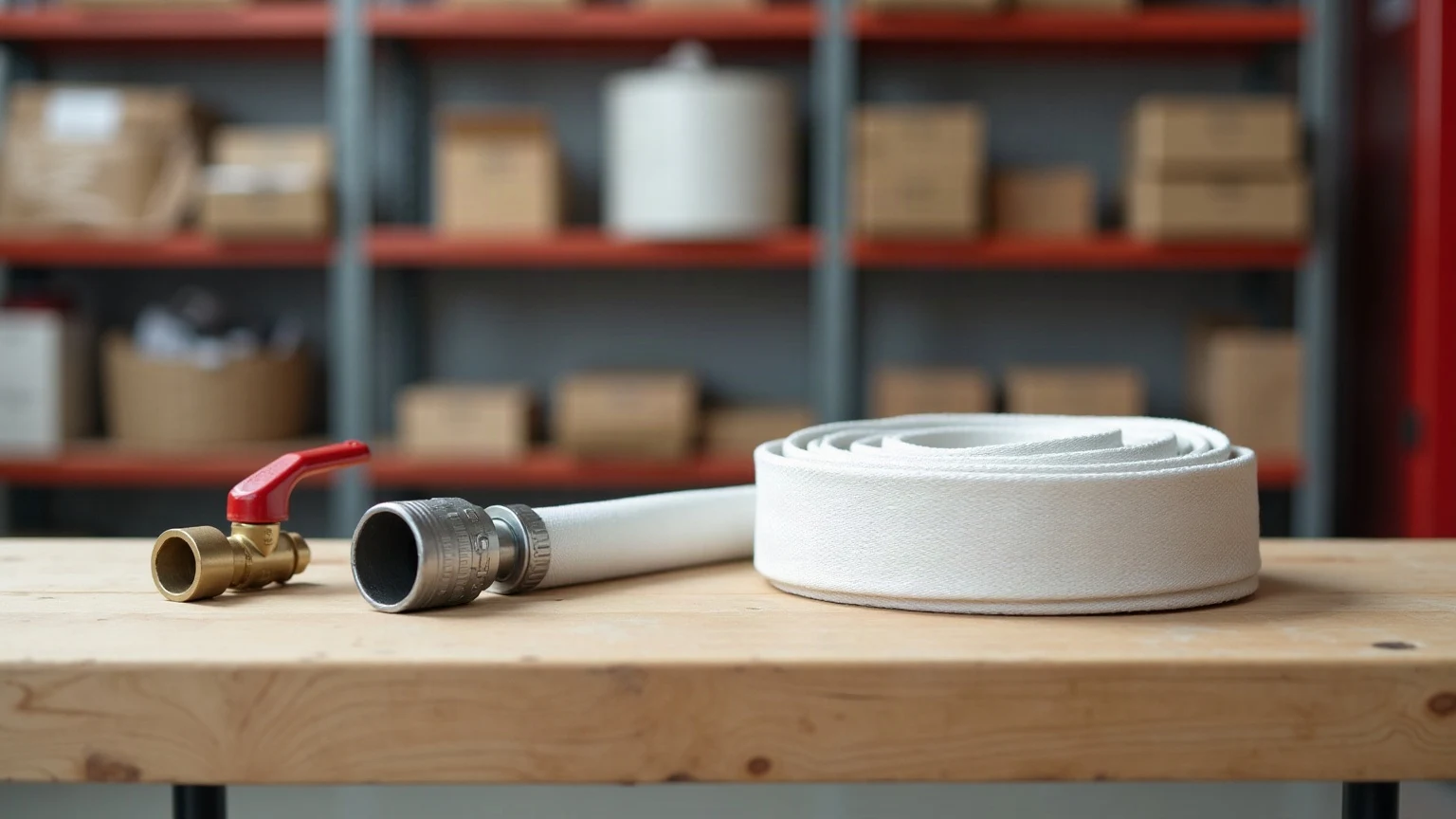
PVC or metal cabinet
The answer depends on the obligation the cabinet covers. If it is installed as a simple water supply network, Regulation 15/2014 explicitly requires a red metal cabinet. A PVC box does not meet this specification, however good it is.
For a cabinet on a permanent fire main, the cabinet is chosen in the fire safety study, together with the valve and the hose. The old 3/1981 required a cabinet of non-combustible materials. If you are considering a PVC cabinet for a space without such an obligation, ask the designer first whether it is acceptable.
Dimensions and mounting
For the simple network the height is set: 1 to 1.5 m above the floor. The regulation gives no outer dimensions for the cabinet. It just has to hold the 20 m hose with the nozzle and open without obstruction.
For the number of cabinets, 3/1981 gave a rule that explains the logic. Each cabinet covered a 30 m radius, that is the 20 m of hose plus a 10 m water throw. Today the number and positions come from the fire safety study of the building.
The cabinet must also be visible and accessible. Regulation 15/2014 requires marking on the cabinet, and 3/2015 prohibits fire protection equipment from being covered by goods or other materials.
Maintenance and inspection
For cabinets with a hose reel or lay-flat hose, maintenance is set out in ELOT EN 671-3. The inspection is carried out every year by a competent person. Every five years all hoses are pressure-tested at their maximum working pressure.
Visible and clear
The cabinet is visible, carries its marking and nothing blocks the door from opening.
Hose
It is checked along its full length for cracks, wear and damage.
Components
Bracket, valve, reel and branch pipe are checked for mechanical integrity and correct operation.
Pressure every 5 years
All hoses are tested at the maximum working pressure of their standard.
After each inspection, keep the date and who carried it out. EN 671-3 provides for inspection records and a maintenance label on every cabinet. If the hose needs replacing, the guide on how to choose a fire hose and how many bar you need helps with the choice.
Common mistakes
Most problems with a cabinet are not technical. They are small changes that happen over time and go unnoticed until the day it is needed:
- Goods, furniture or decorations in front of the cabinet, which 3/2015 prohibits.
- A hose replaced with one of a different diameter or shorter length than the rule requires.
- A branch pipe that is missing or does not fit the hose coupling.
- Couplings of a different system or size from those of the valve.
- A cabinet mounted outside the 1 to 1.5 m height, behind a door or in a corner where it cannot be seen.
- An annual inspection that was not done or not recorded.
Frequently asked questions
What is a fire hose cabinet under Regulation 15/2014?
At what height is a fire hose cabinet mounted?
What specifications must fire hose cabinets meet?
What is a permanent fire main?
What does the price of a fire hose cabinet depend on?
Sources
- Fire Regulation 15/2014, Article 4: Portable and other means of active fire protection. https://nomoskopio.gr/pyr_15_14_4.php
- Fire Regulation 15/2014, Article 3: Permanent active fire protection systems. https://nomoskopio.gr/pyr_15_14_3.php
- Fire Regulation 3/2015, Article 7: Active fire protection means. https://nomoskopio.gr/pyr_3_15_7.php
- Fire Regulation 3/2015, Article 6: Preventive fire protection measures. https://nomoskopio.gr/pyr_3_15_6.php
- Fire Regulation 3/1981, Annex B: Basic data of the fire water network. http://nomoskopio.gr/pyr_3_81_p2.php
- Evangelismos General Hospital of Athens, Technical specifications for fire hose cabinets (2014). https://evaggelismos-hosp.gr/wp-content/uploads/files/BIOIATRIKI/PYROSBESTIKES_FOLIES_STAUMOI_PROSOPIDES/Diav2014-10-05PyrosbedtikesFoliesStathmoi%2CProsopides.pdf
- iTeh Standards, SIST EN 671-3:2009 – Fixed firefighting systems, hose systems, maintenance. https://standards.iteh.ai/catalog/standards/sist/d3308f2b-9742-47c9-8757-101e96e61fd4/sist-en-671-3-2009
Request a quote or information
Fill in the form and we will get back to you as soon as possible.