
EXPLAINER
Fuel hoses: diesel, petrol & safety (EN 1765)
What EN 1765 means on a fuel hose, which fuels and temperatures it covers, what the M and Ω markings say about grounding, and how to tell when a hose needs replacing.
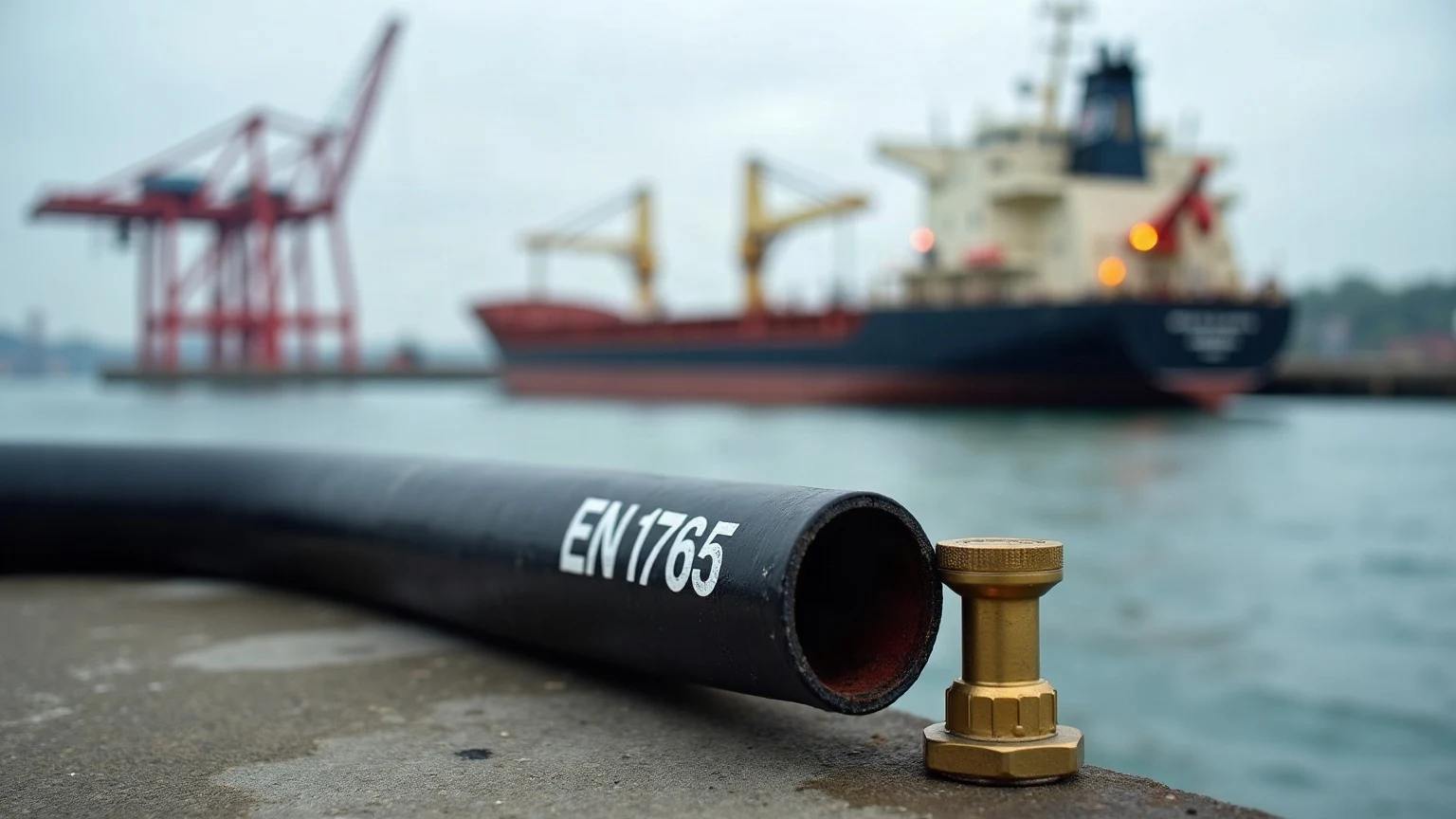
In short: what is an EN 1765 fuel hose? It is a rubber hose, together with its couplings, built to the European standard EN 1765 for oil suction and discharge. The standard covers crude oil and liquid petroleum products with up to 50% aromatic hydrocarbons, temperatures from -20 to +82 °C and nominal sizes from 50 to 500. It does not cover LPG or natural gas.
The EN 1765 marking does not mean “a hose for every fuel”. It is a specific standard for transferring petroleum products, for example when bunkering ships. Below we explain what it defines, what to watch for in the fuel and in grounding, and when you need a hose built to a different standard.
Some of the fuel hoses in our catalogue, each for a different use:

FUEL HOSE PETROL 15, BLACK TUBITHOR 15/60 BAR
For bunkering ships, from -20 to +82 °C, with high-tensile textile plies and a double grounding wire.

FUEL HOSE CARBOPOMP M I5T, TUBITHOR ITALY (TTI5T)
Certified to ISO 7840 A1, at 5/10 bar, for diesel, biodiesel and petrol in boat engines.

GREY FUEL HOSE TUBITHOR 17/51 BAR
For fuel tank trucks, from -35 to +100 °C, with textile plies and a grounding wire.

FUEL HOSE CARBOPOMP 10 20NL, TUBITHOR ITALY (TT CARBO 10)
For hydrocarbons with up to 40% aromatics, from -20 to +70 °C, with an antistatic grounding wire.

FUEL HOSE WITH EXTERNAL TEXTILE BRAID
External textile braid, for petrol, diesel and biodiesel in cars and marine use.
What EN 1765 is
EN 1765 is titled “Rubber hose assemblies for oil suction and discharge services”. The current edition is EN 1765:2016 and it sets the requirements for four types of assembly. An assembly means the hose together with its end fittings, not just the rubber. Elaflex, for example, marks every product with a batch number and production date, details that later also help you check the age of the hose.
The types differ in construction: smooth bore, rough bore, rough bore with armour, and a lightweight type. There are versions with and without electrical continuity. The versions with electrical continuity are either bonded with a wire or conductive.
The marking shows the type and the pressure class. Elaflex, for example, lists hoses in classes L 10 and L 15, where the number is the working pressure in bar. In our shop, this type of hose is in the black 15 bar EN1765 fuel hose category.
Fuel compatibility
The standard covers crude oil and liquid petroleum products with an aromatic hydrocarbon content of up to 50% by volume. For fuels with more aromatics, its requirements can only be used as a basis, and only if the manufacturer agrees. LPG and natural gas are outside its scope.
In practice, the aromatic content is the first thing to check on the hose data sheet. The Tubithor PETROL 15 fuel hose, for example, is rated for petroleum products with up to 50% aromatics, while Carbopomp 10 is rated for up to 40%.
The same hose does not necessarily suit every fuel. WorkSafeBC inspections found transfer hoses in use with fuels they were not designed for, and a hose designed for diesel may not be suitable for petrol. Before running petrol through a diesel hose, check the manufacturer’s fuel list.
Biofuels need a separate check. ISO 7840, for example, covers petrol with ethanol and diesel with FAME, while Trelleborg rates Pumpadukt D for biofuels up to 60 °C, lower than its general temperature limit.
Grounding and antistatic
Static electricity builds up in hoses and pipework when diesel and petrol are transferred. If it is not released in a controlled way, it can discharge as a spark and cause a fire or an explosion. That is why the hose and the equipment need electrical continuity and grounding.
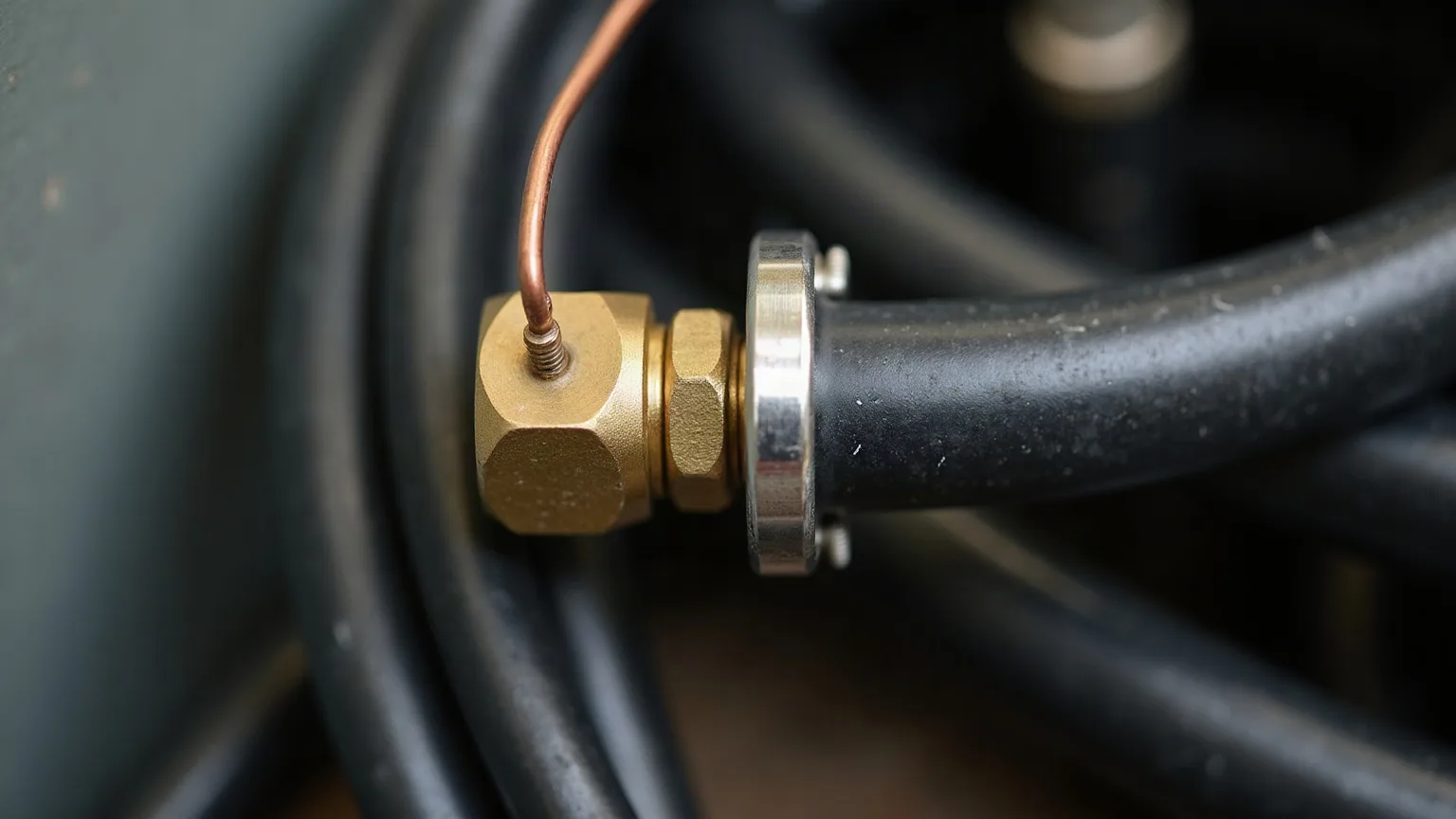
EN 1765 hoses use two methods. The first is wire bonding, marked M: a metal wire inside the hose wall connects the two couplings. The second is conductive rubber, marked Ω, where the inner or outer layer is conductive.
| Marking | Meaning | Assembly resistance |
|---|---|---|
| M | Bonded with a metal wire | Up to 100 Ω |
| Ω | Conductive rubber | Up to 106 Ω |
| No electrical continuity | Insulating hose | At least 25,000 Ω |
Grounding the hose is not enough on its own. The truck or container supplying the fuel must be bonded to the one receiving it, or both must be grounded during the transfer. Electrical continuity is measured with a resistance meter from coupling to coupling, and this test belongs in the hose’s annual programme.
Pressure and temperature
EN 1765 covers working temperatures from -20 to +82 °C. Pressure depends on the hose class: for class L 15, Elaflex gives a working pressure of 15 bar with a safety factor of 4.
Catalogues usually list fuel hoses with two figures: the working pressure and the burst limit. PETROL 15 is rated 15/60 bar and -20/+82 °C, while the grey fuel hoses for tank trucks are rated 17/51 bar. The first figure is the one that counts for the job. The second is the point where the hose bursts, not a value for use.
Temperature also matters at the low end. Below -20 °C an EN 1765 hose falls outside the scope of the standard. For very cold conditions you need a hose with a lower limit, such as the grey tank truck hoses in our shop, rated down to -30 or -35 °C.
Applications and connections
EN 1765 covers the suction and discharge of petroleum products in large diameters. Other uses have other standards, so choose the hose by where it will work:
- Tank trucks and hose reels: hoses such as Trelleborg Pumpadukt D follow the requirements of EN 1761 and EN 12115.
- Boats with a permanently installed fuel system: ISO 7840 sets out fire-resistant hoses for petrol and diesel, with a working pressure of up to 0.34 MPa for inside diameters up to 10 mm. The Carbopomp M I5T in our shop is certified to ISO 7840 A1.
- Cars, small boats and small engines: small fuel hoses, such as the 10 bar braided petrol hose.
The connection must keep both the seal and the electrical continuity. If the hose ends in a camlock coupling, the gasket must withstand the fuel: see the comparison of neoprene and Viton gaskets and the available camlock gaskets. On small hoses with a hose tail, clamping is done with hose clamps, while boats often use brass marine fittings.
Wear and replacement
A fuel hose should be checked visually every time it is used. Replace it immediately if:
- it has visible cracks, tears, blisters or heavy abrasion,
- its outer cover is cut or punctured,
- it leaks at any point,
- it was run over by a vehicle and did not regain its shape,
- it was pulled while still connected.
In addition, Banlaw recommends a hydrostatic test and an electrical continuity or insulation test once a year, and replacement once the hose is more than 5 years past its date of manufacture. Age is counted from the date of manufacture, not from the day the hose went into service. If the tests cannot be done on site, Banlaw suggests periodic replacement, even every 6 months. Where the manufacturer sets its own inspection programme, follow that.
Frequently asked questions
What does EN 1765 mean on a fuel hose?
Is an EN 1765 hose suitable for a tank truck or a boat?
What do the M and Ω markings mean?
Can I run petrol through a diesel hose?
How often should a fuel hose be replaced?
Sources
- iTeh Standards, EN 1765:2016 – Rubber hose assemblies for oil suction and discharge services. https://standards.iteh.ai/catalog/standards/cen/db685128-d906-4244-b78c-73b17ca4f1ac/en-1765-2016
- Elaflex, Information 14.16E. https://elaflex.de/dokumente/download/ElaflexInformation/ELAFLEX_Information_14.16E.pdf
- Trelleborg, Pumpadukt D. https://www.trelleborg.com/en/fluidhandling/products-and-solutions/industrial-hoses/rubber-hoses/oil-petroleum-and-fuels-transfer/pumpadukt-d
- iTeh Standards, ISO 7840:2021 – Small craft, fire-resistant fuel hoses. https://cdn.standards.iteh.ai/samples/79097/e52e5ed840fa411bbfb96cdf9587ee8b/ISO-7840-2021.pdf
- Truck News, Preventing fires and explosions during fuel transfers. https://www.trucknews.com/health-safety/preventing-fires-and-explosions-during-fuel-transfers/1003157368
- Banlaw, Maintaining fuel transfer hoses. https://www.banlaw.com/maintaining-fuel-transfer-hoses/
Request a quote or information
Fill in the form and we will get back to you as soon as possible.