
Explainer
What 1SN, 2SN and 4SP mean on a hydraulic hose
The code printed on the hose tells you how many wire layers it carries and how much pressure it will hold. Here is what separates 1SN from 2SN, where 4SP belongs and how to read the pressure figures.
Every hydraulic pressure hose carries a line of characters along its cover that looks like a warehouse code. It is not: it describes how the hose is built and sets the pressure it is allowed to work at. Read that marking correctly and the choice makes itself.
The three markings you meet most often in workshops and industry are 1SN, 2SN and 4SP. Each is covered below, with the real pressure tables that apply per bore size.
What the EN 853 standard is
EN 853 is the European standard for rubber hydraulic hoses reinforced with braided steel wire. It corresponds to the international ISO 1436-1 and is usually printed alongside the American designation for the same construction, R1 for 1SN and R2 for 2SN. That is why catalogues carry the double marking, for example “EN853 1SN 100 R1 AT”.
The number in front of the letters states how many wire layers sit inside the wall. One braid in 1SN, two braids in 2SN. More wire means the wall holds more pressure, and the hose becomes stiffer with it.
1SN, 2SN and 4SP in practice
1SN is the general purpose hose. One braid, a softer wall, easy to route through tight spaces. It suits return lines, lower working pressures and any application where bend radius matters more than pressure.
2SN is the standard choice for supply lines in machine hydraulic circuits. With two braids at the same bore it holds close to twice the pressure of 1SN. It is stiffer and needs more room to turn.
4SP and 4SH take over where the other two stop: large bores that have to run at high pressure at the same time, typically on earthmoving and heavy machinery. The spiral layers also cope better with the pressure pulses that fatigue a circuit.
In all three the body is NBR nitrile, with an inner lining suited to mineral oils and an outer cover resistant to abrasion, ozone and weathering. The working temperature range for the R1 and R2 hoses in the catalogue is –40 to +100°C.
Working pressure and burst pressure
Two figures accompany every bore size. The first is the working pressure, the maximum the hose may run at continuously. The second is the burst pressure, at which it fails under test. The ratio between them is a constant 4:1 – burst pressure is four times working pressure.
The point that gets forgotten: capacity falls as the bore grows. The same hose type in 1/4″ holds several times the pressure it holds in 2″. Here are the real figures:
| Bore | 1SN (R1) working | 1SN burst | 2SN (R2) working | 2SN burst |
|---|---|---|---|---|
| 1/4″ | 225 bar | 900 bar | 400 bar | 1600 bar |
| 3/8″ | 180 bar | 720 bar | 330 bar | 1320 bar |
| 1/2″ | 160 bar | 640 bar | 275 bar | 1100 bar |
| 3/4″ | 105 bar | 420 bar | 215 bar | 860 bar |
| 1″ | 88 bar | 352 bar | 165 bar | 660 bar |
| 1.1/4″ | 63 bar | 252 bar | 125 bar | 500 bar |
| 1.1/2″ | 50 bar | 200 bar | 90 bar | 360 bar |
| 2″ | 40 bar | 160 bar | 80 bar | 320 bar |
With 4SH and 4SP the picture changes completely at the larger bores: 420 bar working at 3/4″, 385 bar at 1″, 350 bar at 1.1/4″, 300 bar at 1.1/2″ and 250 bar at 2″. That is exactly where the extra cost of spiral construction earns itself back.
The reinforcement layers
Every hose is three things at once: the inner tube that meets the oil, the reinforcement that holds the pressure, and the outer cover that protects against abrasion and environment. The reinforcement is what changes from type to type.
Cross section of the three constructions. Grey shows the wire layers, dark shows the rubber, the centre is the bore.
In practice: every layer added raises pressure capacity and stiffness together. You do not pick the strongest hose “to be safe” – you pick the one that covers the circuit pressure and still has room to bend where it will be fitted.
Hydraulic pressure hoses
The catalogue range, from single braid through spiral constructions to steam hoses.
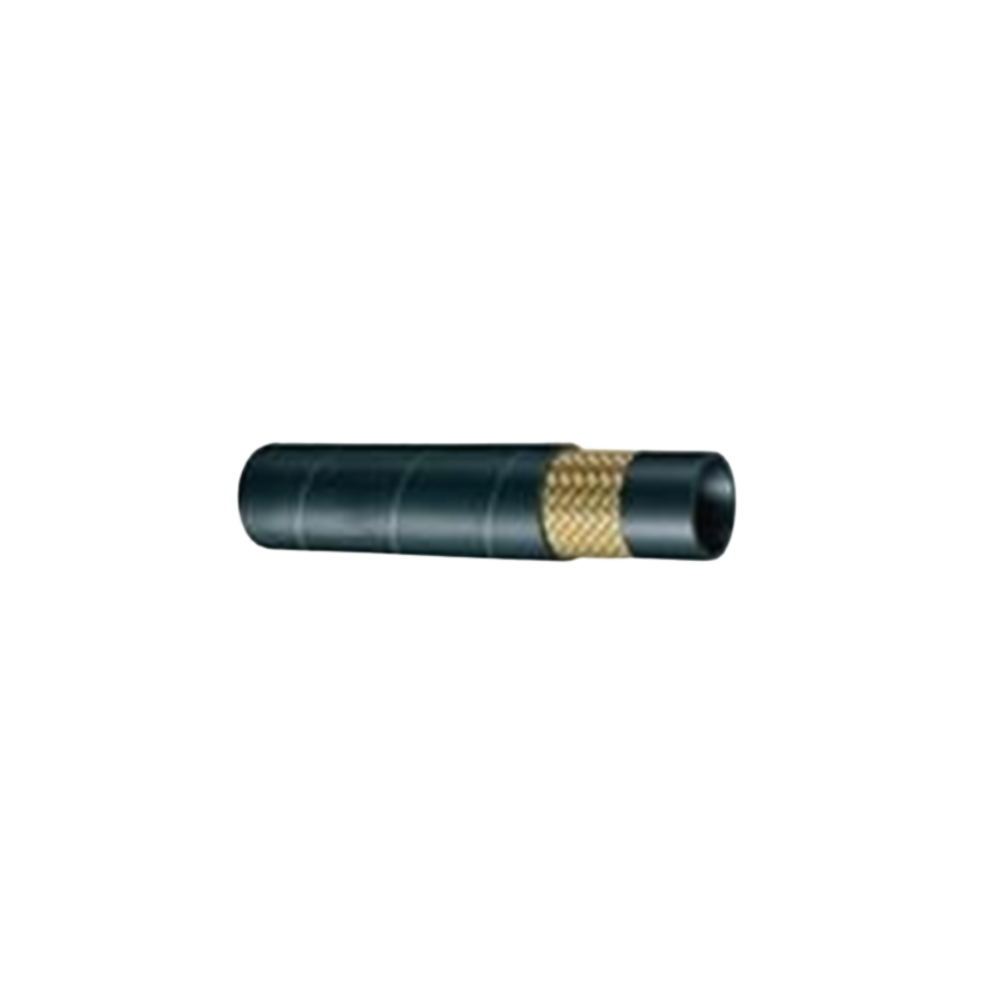
R1-1SN HYDRAULIC HOSE
NBR nitrile with a single wire braid, –40/+100°C.
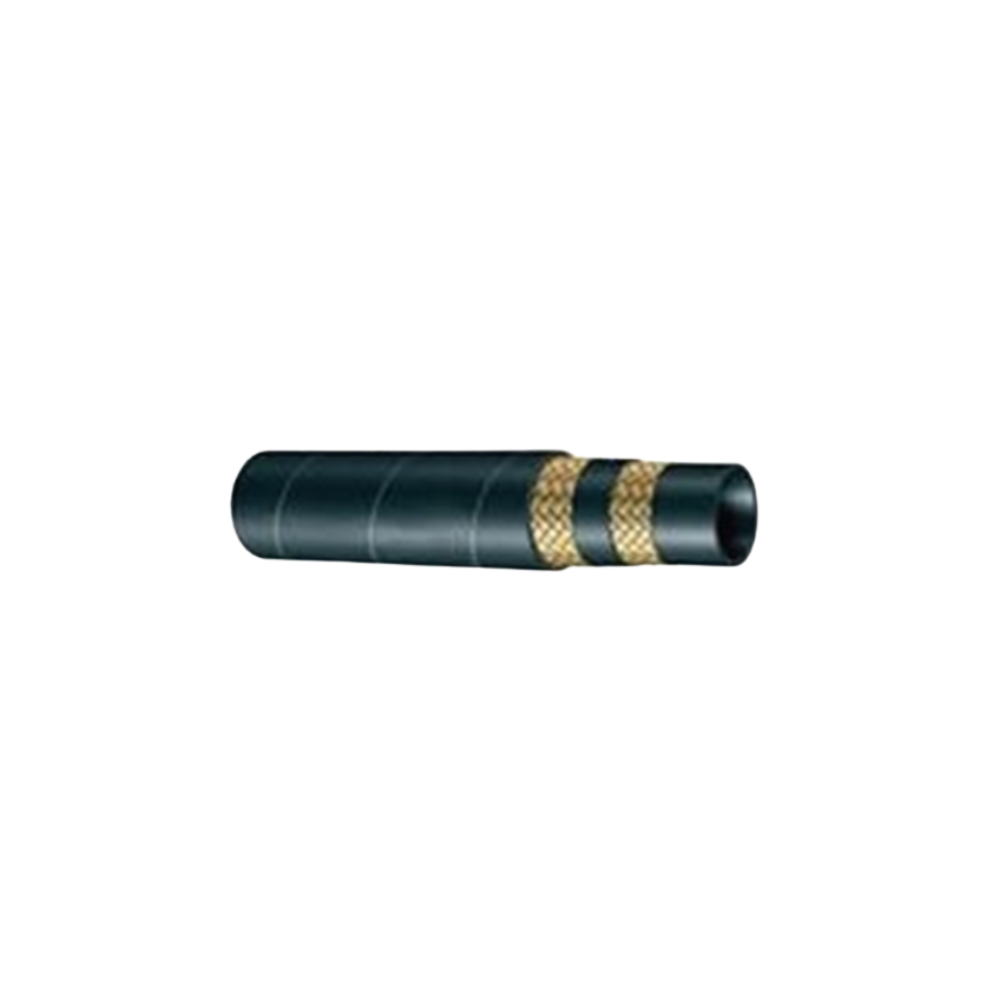
R2-2SN HYDRAULIC HOSE
Two wire braids for high pressure supply lines.

4SH-4SP HYDRAULIC HOSE
Four spiral wire layers for large bore, high pressure lines.
155°C HOT WATER R2 HOSE
R2 construction for hot water pressure washers.

Bend radius and routing
The minimum bend radius is how tightly the hose may turn without damaging its reinforcement. Every bore and every type has its own value, listed in the specification table. Exceed it and the wires on the outside of the curve stretch permanently, so the hose fails well before its time.
Three mistakes cut years off an installation: the curve starting immediately at the fitting instead of leaving a straight section first, the hose cut so short that it goes into tension as the machine moves, and the hose being twisted during fitting. Twist is the worst of the three, because it destroys the geometry of the braid.
Always leave some slack so the hose can absorb the change in length under pressure, and support it wherever it rubs against a metal edge.
Fittings and crimping
The hose is half the job. The other half is the fitting and how it is attached. In high pressure hydraulics the connection is made by crimping: the ferrule is compressed mechanically onto the hose to a specific diameter defined by the fitting manufacturer.
Two rules do not bend. First, the fitting has to match the specific hose type and bore – a 1SN fitting is not crimped onto 2SN. Second, the crimp diameter is measured, not judged by eye. Slightly loose and the hose blows off under pressure; slightly tight and the wires are cut.
Hose clamps have their place on low pressure lines such as fuel delivery rubber hoses, not on high pressure hydraulic circuits. For permanent large bore connections the joint is made with flanges.
View the hydraulic pressure hoses →
Frequently asked questions
What do 1SN and 2SN mean on a hose?
How much pressure does a 2SN hose hold?
Does 4SP belong to EN 853?
Can I fit 2SN instead of 1SN?
Why does a hydraulic hose burst?
What are "markoutsia" (high pressure hoses with fittings) used for?
Request a quote or information
Fill in the form and we will get back to you as soon as possible.